Decision Intelligence Market Opportunity: A Deep Dive with Expanded Market Insights
Understanding the Value of Market Sizing
As a marketing professional and veteran market analyst, I’ve received countless solicitations to purchase market research reports. The latest one from Research and Markets focuses on the Decision Intelligence (DI) market. Market size research isn’t just about the numbers—it’s about understanding why those numbers exist and for whom they matter.
For anyone involved in product development, market sizing serves as a compass. An honest, defensible number guides investments, helps set profit margins, and frames performance metrics. Too conservative an estimate makes it difficult to justify critical resources, while overly ambitious projections risk inflating expectations and disappointing stakeholders.
Entrepreneurs and Investor Perspectives
Entrepreneurs and visionaries face a different calculation. Investors expect to see large total addressable markets (TAM) to justify high-growth potential. A modest TAM signals limited upside, while an optimistic one excites venture capitalists and supports stronger valuations. In this context, market sizing often leans aggressive to capture imagination and secure early-stage funding.
The Complex Landscape of Decision Intelligence
Decision Intelligence isn’t a single market—it’s a convergence of multiple sub-markets. The DecideWise model identifies these as data management, streaming analytics, business intelligence and descriptive analytics, predictive analytics and machine learning, optimization solutions, generative AI solutions, simulation, low-code application development, and integrated platforms.
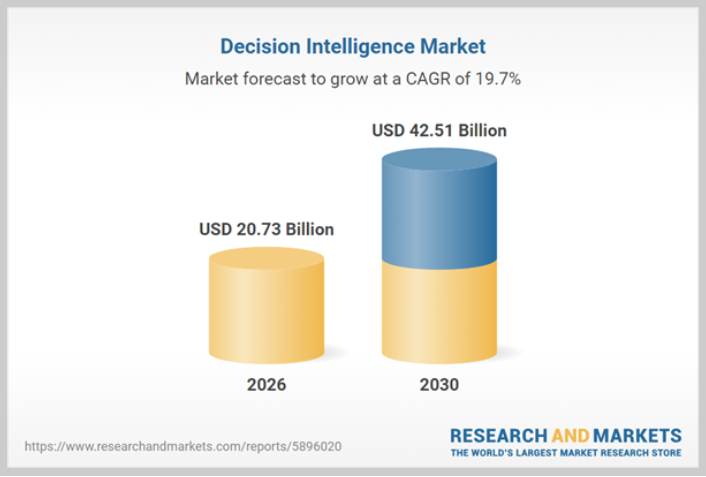
Research and Markets provides a consolidated forecast, valuing the DI market between $17–20 billion today, with projections of $42–74 billion by 2030–2033. This corresponds to a compound annual growth rate (CAGR) of 15–30%, depending on scope. Gartner, by comparison, values the DI platform portion alone at around $15 billion, growing to $35 billion in five years. These differences highlight how definitions impact market sizing.
Contextualizing the Sub-Markets
Each sub-market contributes to the overall DI opportunity. For example, the global data management market —spanning databases, cloud data warehouses, and governance platforms—is expected to surpass $150 billion by 2028 with a 12% CAGR. Analytics platforms, including business intelligence and streaming analytics, total $30 billion today and could reach $60 billion by 2030.
Low-code and no-code platforms, essential for self-service decision workflows, are expanding rapidly. Currently at $22 billion, they could grow to $125 billion by 2032, exceeding 25% CAGR. However, this market is under distinct threat by Vibe Coding methodologies that can potentially undermine and market progress achieved by low-code solutions. This was covered in an earlier blog by DecideWise member, John Rymer, The Dawn of the AppGen Platform.
Meanwhile, AI solutions—both predictive and generative—represent the most dynamic segment, projected to grow from $200 billion in 2025 to over $500 billion by 2030, with DI-aligned applications capturing a growing share.
This analysis however, doesn’t include a number of the other markets included in Decision Intelligence including optimization solutions, digital twins and simulation, general application development and decision rules.
Key Drivers of Market Growth
Several trends are accelerating DI adoption. Agentic AI and autonomous workflows are enabling widespread decision automation. Cloud-native architectures have lowered barriers to real-time analytics. Additionally, regulatory pressures, global supply chain challenges, and the drive for operational efficiency are embedding DI into enterprise strategy.
North America leads the market with over 35% of global revenue, driven by industries like BFSI, IT, retail, healthcare, and advanced manufacturing. While large enterprises generate around 75% of revenue today, small and mid-size businesses are the fastest-growing users as cloud-native platforms reduce entry costs.
Turning Opportunity into Execution
For organizations evaluating DI, the market’s potential is clear—but success requires more than riding the growth wave. Companies must identify the sub-markets most relevant to their operations, choose the right platform strategy, and deliver differentiated solutions to real users.
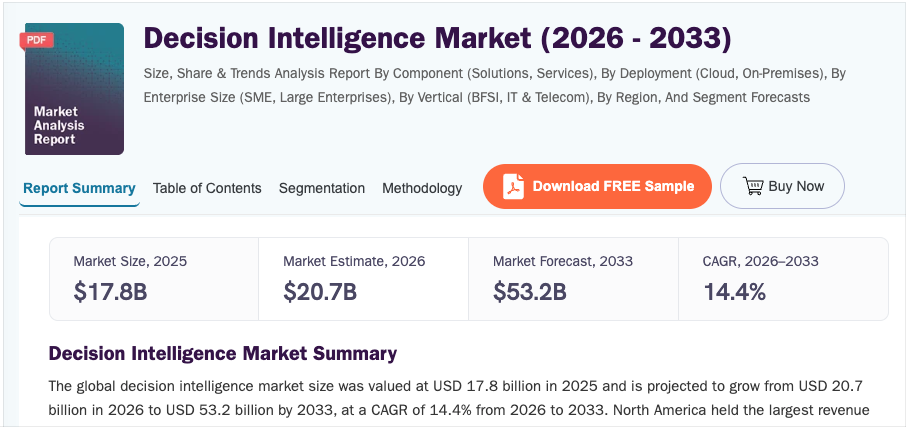
A TAM number is useful for investors and budget approvals, but real growth comes from execution—building solutions that solve pain points, training sales teams to communicate value, and iterating based on early feedback. The projected $42–74 billion market is compelling, but those dollars will flow to companies that convert market potential into tangible, repeatable outcomes.
The Bottom Line
Decision Intelligence is growing rapidly, fueled by trends in data management, analytics, AI, and low-code development. Its projected expansion highlights its strategic importance. Yet, true success lies less in the size of the TAM slide and more in creating clear, differentiated solutions that deliver measurable business impact.
---
¹ https://www.researchandmarkets.com/report/decision-management-solution
² https://www.grandviewresearch.com/industry-analysis/decision-intelligence-market-report
³ https://finance.yahoo.com/news/decision-intelligence-market-reach-usd-144500440.html
⁴ https://www.fortunebusinessinsights.com/decision-intelligence-market-108592
⁵ https://www.technavio.com/report/decision-intelligence-market-industry-analysis