Categorizing and Triaging Enterprise Decisions: Decision Velocity Part 2
This is the second post in our series on implementing Decision Velocity. If you missed it, you can read the first installment, “Auditing for Decision Velocity,” here.
As we discussed in last week’s post—and as Carl Spetzeler highlighted in “The Decision Making Continuum: Will Decision Intelligence Unite Automation and Human Judgment?”—not all decisions are created equal. Enterprise decisions generally fall along a continuum across three categories: Strategic, Operational, and Tactical.
Too often, organizations fail to categorize decisions or understand what truly sets them apart. This oversight is a major barrier to improving agility. Some decisions cannot (and should not) be rushed, while others desperately need to be accelerated. Recognizing these distinctions is the critical next step in unlocking overall Decision Velocity.
Understanding Frequency and Risk
While Spetzeler describes decisions along a continuum from strategic to tactical, the real defining characteristics for any decision lie across two dimensions: frequency and potential risk.
Mapping your organization's choices onto a 2x2 Risk vs. Frequency matrix provides immediate clarity on where to focus your resources:
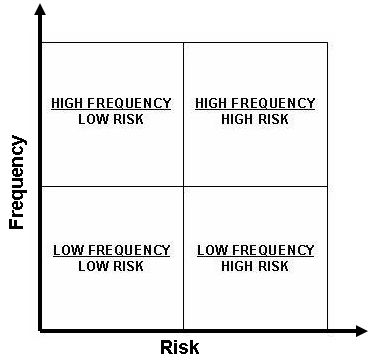
1. High-Frequency, Low-Risk: These are high-volume, repetitive operational decisions: lead routing, routine expense approvals under $50, customer engagement offers, and standard inventory reorders. Each individual decision carries minimal risk to the bottom line, but they occur minute-by-minute or thousands of times a day. In high-volume transactional environments, these happen millions of times per hour.
2. High-Frequency, High-Risk: These decisions occur rapidly in real time, but carry significant downside if executed incorrectly. In medicine, a surgeon makes split-second choices during an operation that directly impact a patient's life. In daily life, driving requires constant scanning, evaluating, and adjusting to avoid accidents. In business, key examples include high-dollar credit underwriting, algorithmic trading, and real-time enterprise fraud detection.
3. Low-Frequency, High-Risk: These are mission-critical choices made by executives and boards of directors—such as mergers and acquisitions, enterprise platform migrations, executive hires, or strategic market pivots. These decisions occur infrequently, but they put millions or billions of dollars on the line. They require deep analysis, rich data insights, and experienced human intuition to evaluate complex trade-offs.
4. Low-Frequency, Low-Risk: These are everyday administrative or tactical choices: picking a team-building venue, updating internal documentation templates, or choosing between meeting dates. While teams often spend unnecessary time debating these choices, they have negligible impact on business performance. (Note: Watch out for hidden dependencies—sometimes a decision that appears low-risk on the surface actually carries high strategic risk).
Categorizing your operational choices this way reveals which decisions can be automated, which require human oversight, and which deserve minimal organizational effort. Automating routine choices first frees up cognitive bandwidth for strategic ones.
Triaging Decisions for Automation
Once you’ve mapped your decisions, how do you prioritize which ones to automate? The key decision factor is evaluating where and how human judgment adds value relative to risk.
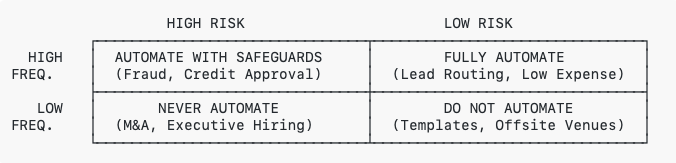
• High-Frequency, Low-Risk ==> 100% Automate: High volume with low downside makes these ideal for rule-based, zero-latency execution.
• High-Frequency, High-Risk ==> Automate with Safeguards: Systems process data instantly to handle velocity, but require strict guardrails, automated anomaly detection, and human escalation protocols.
• Low-Frequency, High-Risk ==> Never Automate (Human-Led): These require context, ethical reasoning, and strategic vision. Use automation purely for data gathering, modeling, and decision support.
• Low-Frequency, Low-Risk ==> Do Not Automate: Low volume means building complex automation yields poor ROI. Rely on standard templates or simple delegation instead.
The Role of Human-in-the-Loop (HITL)
Maintaining a human perspective is vital across every decision category—whether automated or manual.
For low-frequency, high-risk decisions, human judgment is the central engine. Automation should not replace the leader; instead, data engines and business intelligence serve a decision-support role by delivering clean, relevant insights at the right moment.
For high-frequency automated processes, human involvement shifts to governance. Implementing human oversight, intervention workflows, and routine audits ensures your systems maintain proper controls, guard against drift, and stay aligned with evolving business goals.
How DecideWise Can Help
DecideWise works closely with the Society for Decision Professionals, along with consulting partners like Blue Polaris and DecisionBrain, to help organizations analyze and articulate their decision requirements.
Decision rules and Business Process Management (BPM) systems provide the orchestration engine for automated decisions, while strategic consulting and business intelligence power informed, human-led choices. In both cases, defining, documenting, and scaling your decision framework drives measurable improvements in decision velocity.
Next week, we’ll explore the next phase in the Decision Velocity framework: Translating strategy into execution—defining and coding decision rules and business logic.